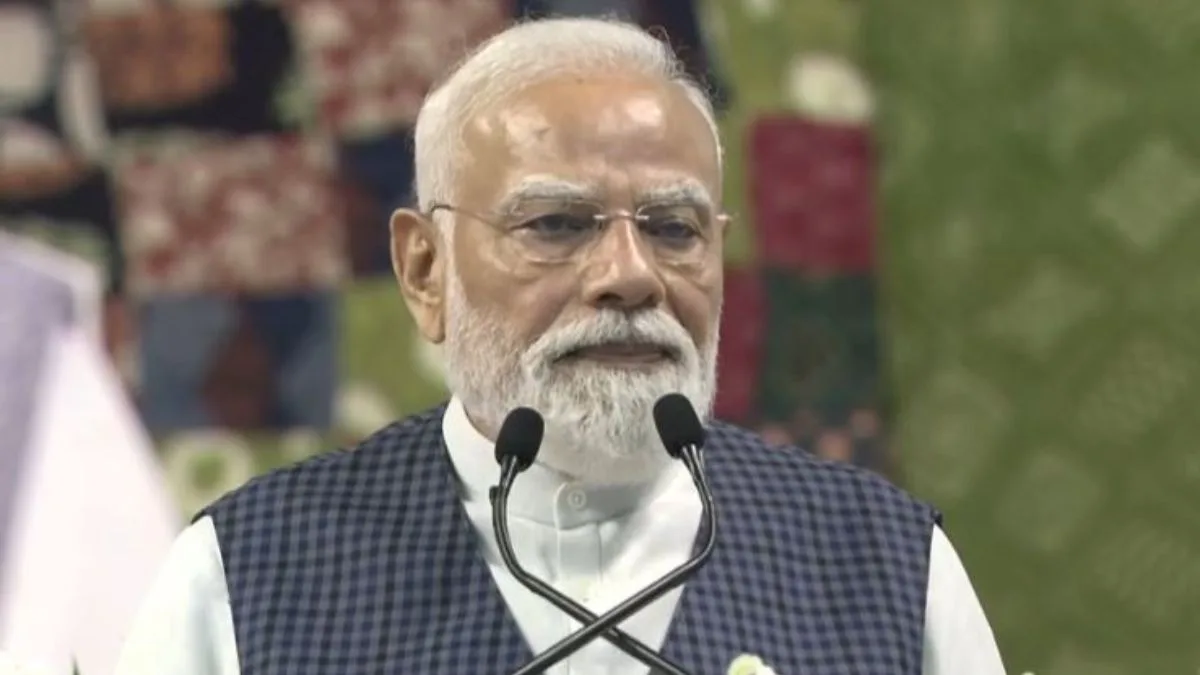
Prime Minister Narendra Modi on Monday, May 11, received a grand welcome as large numbers of people gathered for the Somnath Amrut Mahotsav, marking 75 years since the inauguration of the restored Somnath Temple.
To mark the special occasion, a large number of people had lined up along the nearly 1.5-km route from the helipad to Veer Hamirji Circle near the famous Somnath Temple to greet the Prime Minister. They waved flags and raised slogans as his convoy passed through the area.
Advertisement
The Somnath Amrut Mahotsav commemorates 75 years since the inauguration of the restored temple by India’s first President, Dr Rajendra Prasad, in 1951. Notably, the Somnath Temple is one of the 12 Jyotirlingas and is a symbol of India’s enduring faith and civilisational heritage.
The renowned temple was attacked and razed multiple times by Muslim invaders between the 11th and 18th centuries. It boasts a rich and ancient history, serving as a repository of heritage. As per reports, historians believe that the temple was attacked at least 17 times and was plundered by the Mughals.
For centuries, the Somnath Temple in Gujarat has drawn the reverence and prayers of millions of devotees. It was repeatedly targeted by invaders whose intent was destruction, not devotion. However, the story of the temple is defined by the indomitable courage, faith as well as resolve of crores of dedicated followers.
Major attacks on Somnath Temple
The temple is believed to have faced its first major recorded attack by Mahmud of Ghazni in January 1026. This led to the start of a long period during which the temple was repeatedly destroyed and rebuilt over the centuries.
According to girsomnath.nic.in, during the 1026 attack Mahmud of Ghazni had raided and plundered the Somnath temple, breaking its Jyotirlinga. He even took away a loot of 20 million dinars. Thereafter, it was Kumarapala, who rebuilt the temple in “excellent stone and studded it with jewels,” according to an inscription in 1169. Later on, he replaced a decaying wooden temple.
In 1299, Alauddin Khalji’s army, led by Ulugh Khan, defeated the Vaghela king Karna, and sacked the Somnath temple. Post that, the temple was rebuilt by Mahipala I, the Chudasama king of Saurashtra in 1308, while the Jyotirlinga was installed by his son Khengara sometime between 1331 and 1351.
The temple was destroyed for the third time in 1395 – this time by Zafar Khan, the last governor of Gujarat under the Delhi Sultanate and later founder of Gujarat Sultanate.
Reconstruction of Somnath Temple
On Kartak Sud 1, Diwali day i.e. November 12, 1947, Sardar Vallabhbhai Patel visited the ruins of Somnath and expressed his determination to rebuild the temple, with his vision deeply rooted in the belief that the restoration of Somnath was essential to restoring India’s cultural confidence.
The reconstruction was undertaken with public participation and national resolve.
The Somnath Temple, built in the Kailash Mahameru Prasad architectural style, was consecrated on May 11, 1951, in the presence of Dr Rajendra Prasad.